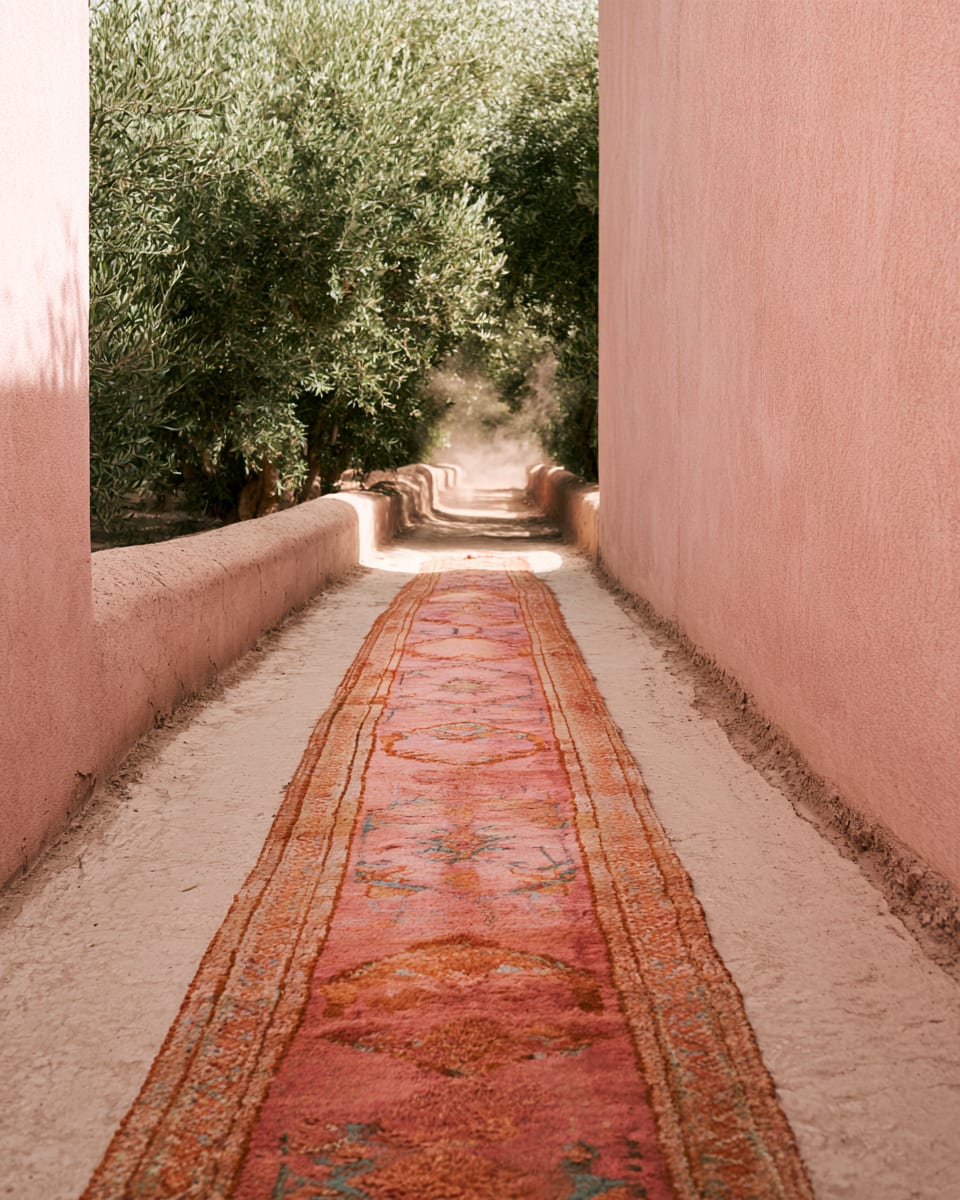
The runner in a long hallway
How long and how wide a vintage runner should be for a hallway, how much floor to leave bare, and why stripes and old colour suit the narrow room.
The key turns, the door swings, and before the sitting room, before the kitchen, before anyone has taken off a coat, there is the hallway. It is the room everyone walks through and nobody furnishes. A console that holds the post, a hook for the dog lead, and a long stretch of bare boards that echoes every step.
A runner changes that in one gesture. Laid down the middle of a corridor, a narrow strip of old wool turns a passage into a room with a beginning and an end, and the house starts at the front door instead of three metres further in.
The size is the part people get wrong, and the rules are short. The runner should not touch the walls. Rug makers quoted by Ideal Home put the margin at 10 to 15 centimetres of bare floor on each side, centred so the border is even, never flush against the skirting. At the ends, stop 15 to 30 centimetres short of the walls and leave the doors free to swing. And go long: the same advice wants the runner to cover at least three quarters of the hall. A runner that is too short reads as a mat that wandered off, and that is the one mistake nobody walks past without noticing.
So a corridor of a metre wide wants a runner of roughly 70 to 80 centimetres. A hall of five metres wants something close to four. Before buying, mark the footprint on the floor with masking tape and live with it for a day. The tape tells the truth about doors, radiators and the corner where the shoes pile up.
A very long hall can take two runners end to end, with a short gap of floor between them, the way a train has carriages. If there is a console or a bench, line the runner up with it so the room reads in one direction.
Then the pattern, which in a hallway is not decoration but strategy. Designers interviewed by Homes & Gardens favour pattern where feet come and go, because a busy field hides the grit that comes in from the street. Stripes do a second trick. Running along the hall, they pull the eye forward and make it look longer. Running across it, they push the walls apart and make it feel wider. A Moroccan runner built from bands, a field of stripes or a ladder of lozenges down the centre, does exactly this without trying.
Colour can be bolder here than anywhere else in the house. A hallway is passed through, not sat in, so a run of madder red or a Middle Atlas plum that might feel loud in a bedroom simply feels like arriving. In a pale house, it is the one place to let colour in at full strength, and to pick one shade from it for a cushion or a print further in so the rooms talk to each other.
Age helps a runner more than any other rug. Decades of feet have already pressed the pile low, so the wool lies flat and firm, the door clears it, and nothing catches a heel. The colour has gone soft at the centre where people walked, a little brighter at the edges where they didn't, and the next ten years of boots will add to that rather than spoil it. A faded runner hides wear because it is already made of it.
On wood, stone or tiles, put a thin anti-slip underlay beneath it. The same designers note that it does two jobs: the runner stops creeping, and the hall goes quiet, the echo of footsteps on bare boards swapped for the soft thud of wool.
Light finishes it. Most hallways get daylight from one end only, a fanlight over the door or a window at the far end, and a runner catches that light along its length the way a path catches the sun at evening. Come home in the dark, switch on one lamp, and the first thing in the house is a stripe of warm wool leading in.
The gallery lists every rug with its length and width in centimetres, so the narrow pieces are easy to find. Measure the hall, mark it in tape, and the right runner is already half chosen.