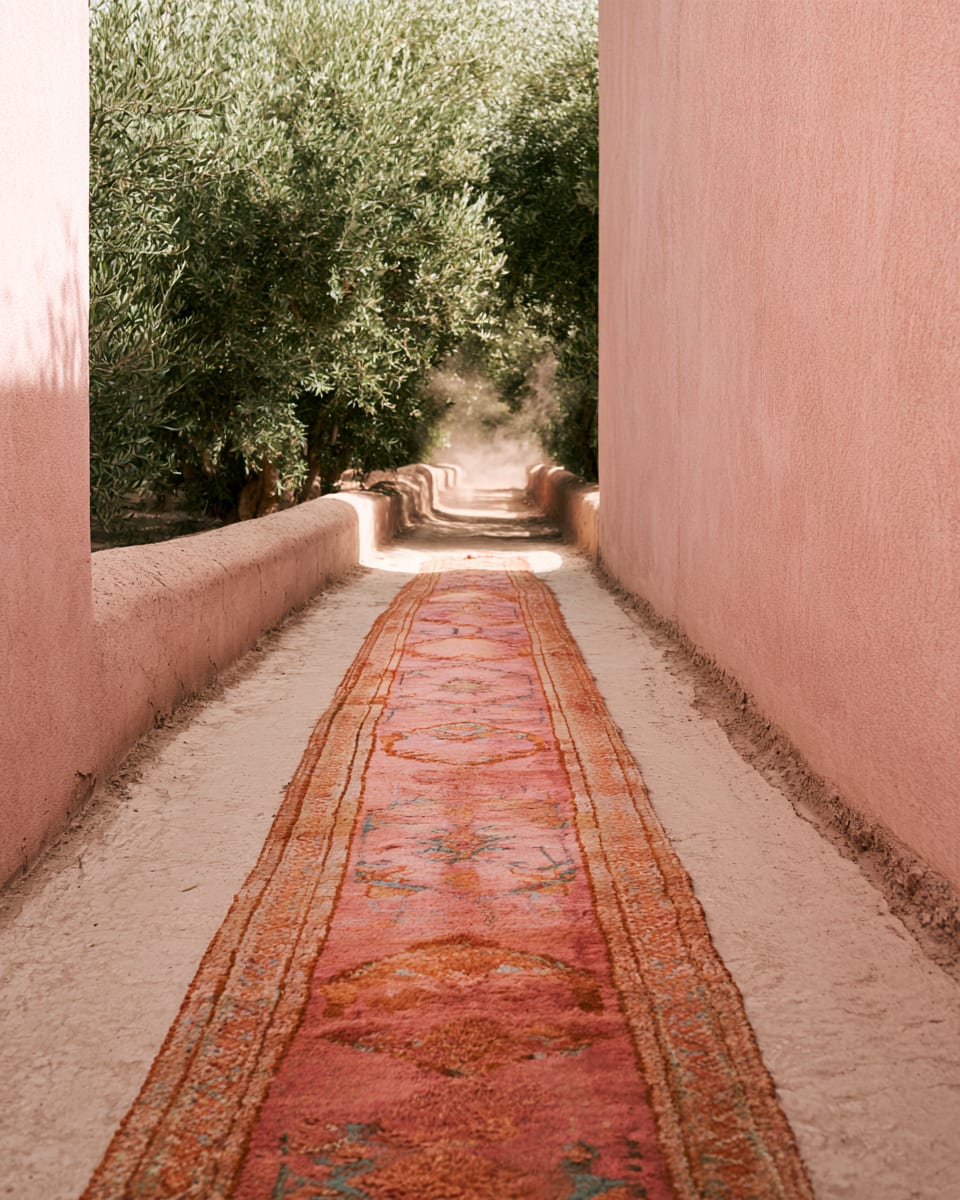
A colourful Boujad in a white room
Why designers lay one painterly Boujad rug in a pale room instead of hanging art, and how to let its pinks and oranges carry the whole space.
The walls are white and empty. Somebody has been meaning to buy a painting for two years. The sofa is linen, the floor is pale wood, the shelves hold a few books and a bowl. Then a vintage Boujad is unrolled in the middle of it all, a field of faded rose and apricot with lozenges that wander off the grid, and the question of the painting quietly goes away.
That is the idea in one sentence: in a pale room, a colourful rug can do the work of art, and do it lying down. A white room is a gallery wall turned on its side. The floor is the largest surface in it, and the one place a picture can be the size of the room.
Designers say this plainly. The Atlanta designer Bradley Odom calls rugs a low-risk place to be playful, because they sit at ground level and furniture covers part of them. Kathy Kuo says that in a neutral room a bright, statement-making rug becomes the design itself. Alex Morrison goes further and says buying a rug is like buying a piece of art for the living room. A Boujad takes the comparison literally.
The rugs come from around Bejaâd, a town on the northern edge of the Tadla plain, south of the Middle Atlas, about sixty kilometres north of Beni Mellal. It grew up around a Sufi lodge founded at the end of the sixteenth century, and the pile rugs woven in the countryside around it are known for colour first and rules second. Diamonds lean. Borders start on one side and forget themselves on the other. Reds drift into pink, orange into rust, and in an old piece the sun and decades of washing have softened all of it towards the colour of a late afternoon. Collectors reach for the word painterly, and for once it is accurate.
That freedom is exactly why it suits a white room. Straight walls, square windows and a rectangular sofa give the eye a grid. The rug breaks it, softly, with a drawing made by hand and from memory. Nothing else has to be loud.
The styling follows from there. Keep the walls bare, or nearly. One small framed drawing is fine; a gallery wall would start an argument. Let the sofa and chairs stay in calm, undyed colours, linen, oatmeal, chalk, so the rug is the only voice. The rug designer Malin Glemme puts it simply: with a colourful rug, choose a calmer palette around it.
Then borrow one colour from the rug, not all of them. A single cushion in the dusty pink, a terracotta pot, a book spine in the same orange on a shelf across the room. Kuo suggests matching cushions to the rug when the sofa is neutral, and repeating small bursts of a colour rather than chasing exact matches. Three echoes are enough. Ten, and the room becomes a theme.
Size changes the effect. A Boujad large enough for the front legs of the sofa and chairs to stand on it, often around 200 by 300 centimetres, turns the whole seating group into one composition, like a painting with a frame of bare floor around it. A smaller piece, closer to 150 by 250, works as a single bright panel in a bedroom or at the foot of a staircase, where it is the first thing seen from the door. Leave a margin of floor visible on every side, as a mount does for a print.
Light matters more than with any pale rug. Morning light from the side brings out the shifts in colour where one batch of wool gave way to the next; evening lamplight warms the pinks towards coral. Put the rug where the light falls across it, not straight onto it.
Vintage is the version that works best. A new rug in these colours can look bright for a white room, close to sweet. An old one has already been toned down by forty summers. The reds have gone gentle, the oranges soft, the pile flattened a little where people crossed it, and the whole surface reads less like decoration and more like something that has always been in the house.
The Boujad pieces in the gallery are each measured in centimetres, end to end, because the first question in a white room is how much floor the painting will cover.