Beni Ourain in a minimalist living room: the one soft thing
Why a cream Beni Ourain finishes a white, bare living room, and how big it should be under the sofa: the sizes designers use, in centimetres.
The room is nearly done. White walls, a pale oak floor, a low linen sofa, one lamp, one chair. Everything is right and the room still feels like a gallery after hours. Then a cream Beni Ourain goes down, and the room becomes a place to sit.
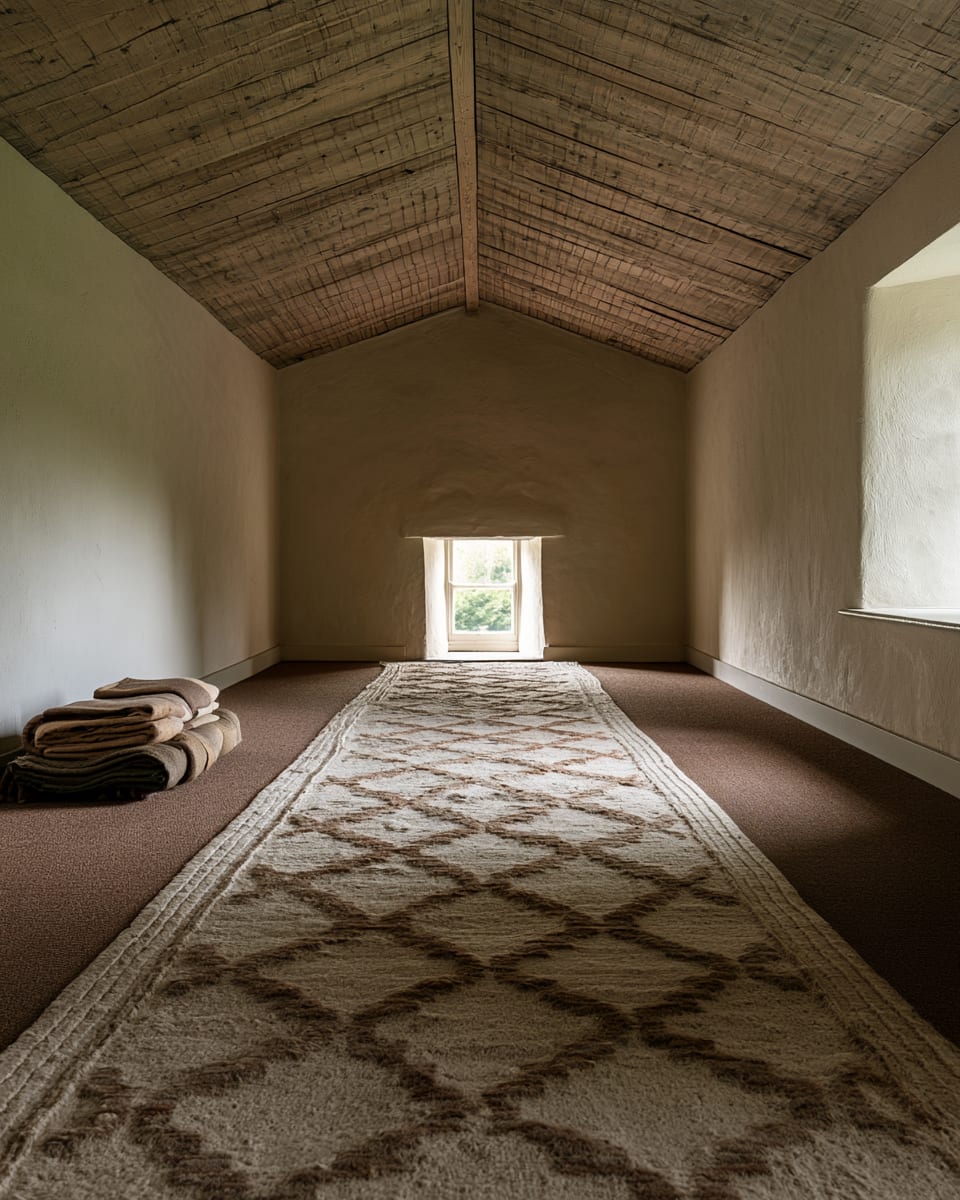
That is the whole trick of a minimal living room: it needs one soft thing, and the softest thing in it should be the floor. A deep pile of undyed wool, the colour of the sheep, crossed by a few dark lines that wander, gives a bare room the warmth it was missing without adding a single object. Nothing on the walls has to change. Nothing on the shelves has to be bought.
Designers worked this out a century ago. In the 1920s Le Corbusier laid Moroccan pile rugs in the Villa La Roche in Paris, and Alvar Aalto put rugs of the same tradition on the floors of the Villa Mairea in Finland. A 1938 photograph of Fallingwater shows one in Frank Lloyd Wright's house. The architects who stripped rooms back to plaster, glass and steel kept one thing from the mountains, and it was wool.
The reason is in the rug itself. A Beni Ourain is cream, so it never fights a white wall; it sits a shade warmer, the way milk sits beside paper. Its lines are drawn by hand, from memory, so the lozenges narrow and drift and stop short. A minimal room is all straight edges, and a rug that is very slightly crooked is the one thing that tells you a person lived here. The pile does the rest. It is deep enough to sink a foot into, it softens the echo that bare rooms have, and in the afternoon it holds the light.
Size is where most rooms go wrong, and a minimal room shows every mistake. A small rug floating in front of the sofa looks like a bath mat that wandered in. The rug should anchor the sofa, not sit beside it.
The simplest rule, used by most designers, is to let the front legs of the sofa and the armchairs stand on the rug, with the back legs on the floor. Domino puts it at a third of each piece on the rug at least, so the group reads as one. If the sofa floats in the middle of the room, the rug can run all the way under it, and the designer Victoria Hagan likes about 25 centimetres of wool showing past the sofa's edge. Either way, leave about 20 centimetres of rug beyond each end of the sofa.
In numbers: a sofa of 220 centimetres wants a rug at least 260 centimetres long, and the long shape of a Beni Ourain helps. Old Middle Atlas rugs often run close to twice as long as they are wide, so a piece of about 200 by 300 centimetres lies along the length of the sofa, reaches under the front legs, and carries on beneath the coffee table. Leave a band of bare floor around it, wide enough to read as a frame. On pale oak, that band is part of the composition.
Keep everything else quiet. One rug, not two layered. A low table in wood or stone, so the pile shows around it. A throw in the same family of creams rather than a second pattern. In a white room the rug is the drawing, and a drawing wants a margin.
Vintage pieces suit this room best. Decades of feet have flattened the pile a little and softened its edges, the cream has warmed towards ivory, and the lines have faded to the brown of strong tea. A new rug can take years to arrive at that colour. An old one walks in already there.
The Beni Ourain pieces in the gallery are measured in centimetres, at both ends, because no two come off the loom the same. The tape goes along the sofa first. The wool comes after.